Blackjack Rules for Beginners and How to Play the Card Game

Blackjack has remained popular for a simple reason. The basic blackjack rules are easy to learn, yet every hand gives you a decision to make. Your goal is to get closer to 21 than the dealer without going over. You do not need to beat the other players at the table, and you do not need a complicated scoring system.

For readers who would rather explore the game online before approaching a physical table,Winna is a practical place to look. Its Originals selection includes Blackjack alongside faster games, while the platform offers mobile-ready navigation and crypto-friendly payments for eligible players.

Knowing that the target is 21 is only the beginning. You also need to understand card values, when to hit or stand, what doubling and splitting mean, and why the dealer's visible card matters. This beginner's guide covers those essentials without turning a relatively simple card game into something harder than it needs to be.

Introduction to Blackjack and the Object of the Game

Blackjack is a card game played between each individual player and the dealer.

The object of the game is to finish with a total closer to 21 than the dealer without going over 21. If your cards total more than 21, you bust and lose that hand immediately.

Card values are straightforward:

  • Cards from 2 through 10 are worth their printed number.

  • A jack, queen or king is worth 10.

  • An ace can count as either 1 or 11, whichever produces the better valid hand.

  • An ace plus a 10-value card as your first two cards is a natural blackjack.

That last point is important.

Suppose your initial two cards are an ace and a king. The two cards total 21 and form a blackjack. If instead you receive 7, 7 and 7, your cards also add up to 21, but the hand is not a natural blackjack because it required a third card.

A natural blackjack can also have a special payout. Many traditional games use 3:2, while some tables pay 6:5 or use other conditions. Always check the displayed rules before placing a bet rather than assuming every table works the same way.

Blackjack Rules From the First Deal to the Dealer's Turn

A round begins when players place their bets.

Each player is dealt two cards. In many versions, the dealer also gets two cards with one card face up and the other kept facedown as the hole card. In some variants, the dealer receives the second card later instead.

Once you receive your first two cards, you choose how to proceed.

Hit

Taking a hit means asking for another card.

You can usually continue taking cards until you decide to stand or your total goes above 21.

For example, if your first two cards are a 6 and 7, you have 13. You may decide to take one more card based partly on what the dealer shows.

Stand

Standing means keeping your current hand and taking no additional card.

Once you stand, your turn is over and the dealer eventually compares the completed hands.

Double down

Doubling down allows you to increase your wager, usually by an amount up to your original bet, in exchange for receiving only one additional card.

It can be useful when the first two cards put you in a favorable position, but it removes your ability to keep hitting afterward.

Split

When you receive two eligible cards of the same value, the rules may allow you to split them into two hands.

A second wager is placed and each card becomes the start of a separate hand.

Surrender

Some versions offer surrender.

This lets you give up the hand under specified conditions and recover part of your original wager rather than playing it to completion.

Not every table offers every action, which is why checking the rules before play matters.

How the Dealer Plays a Blackjack Hand

Players can make strategic choices. The dealer generally cannot.

After the players finish, the dealer reveals the hole card where applicable and follows fixed instructions set by the game.

A common rule requires the dealer to keep taking cards until reaching at least 17. However, there is an important distinction between a hard 17 and a soft 17.

A hard 17 could be 10-7.

A soft 17 could be ace-6, where the ace currently counts as 11.

Some games require the dealer to stand on soft 17. Others require the dealer to hit. That small difference affects basic strategy and the mathematical conditions of the game.

The result of the hand is then determined.

You normally win when:

  • Your total is higher than the dealer's without exceeding 21.

  • The dealer busts and you have not already busted.

  • You get a blackjack and the dealer does not.

You normally lose when:

  • You go above 21.

  • The dealer finishes closer to 21.

  • The dealer has a blackjack and you do not.

If both hands have the same qualifying total, the result is usually a push and the original wager is returned.

If both you and the dealer have a natural blackjack, that is also normally a push.

Why Blackjack Rules of Play at Casinos Can Vary

One of the biggest beginner mistakes is learning one set of rules and assuming it applies everywhere.

Different blackjack tables can change details such as:

  • Number of decks

  • Whether the dealer hits or stands on soft 17

  • Blackjack payout

  • Whether surrender is available

  • Whether players can double after splitting

  • Which totals can be doubled

  • How many times pairs can be split

  • Special rules for split aces

These differences can affect blackjack odds as well as the correct strategy.

That makes the rules card at the table more important than many newcomers realize. Two games can look virtually identical while having different conditions.

Pay particular attention to the payout for a natural blackjack. A 3:2 game and a 6:5 game are not equivalent simply because the cards and table layout look the same.

Blackjack Strategy Starts With the Dealer's Card

Blackjack strategy is not about predicting the next card.

Instead, basic strategy uses the cards in your hand and the dealer's first card to identify the mathematically preferred action under a particular set of rules.

That distinction matters because the dealer is constrained by fixed instructions.

If the dealer shows a relatively weak card such as 4, 5 or 6, there are situations where standing makes sense even when your own total looks unimpressive. The dealer still has to complete the hand and may bust.

When the dealer shows a strong card such as 9, 10 or ace, the situation changes. You may need to take another card with totals you would otherwise stand on.

Basic strategy cannot guarantee that a hand will win. It simply helps prevent avoidable decisions based on hunches, superstition or an incorrect understanding of the probabilities.

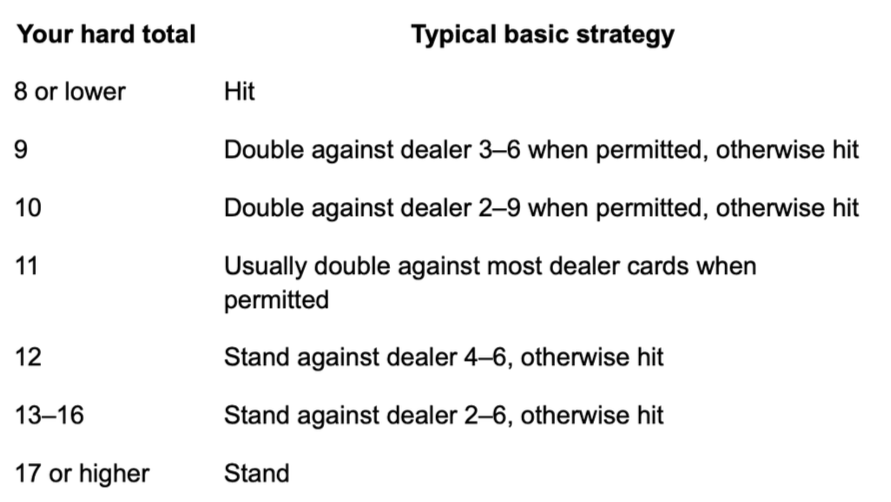
Basic Blackjack Strategy for Common Hard Totals

The following quick guide reflects common multi-deck basic strategy principles. Exact decisions can change with the rules, particularly surrender and soft-17 conditions.

This is why there is no useful universal rule such as "always hit 15." The dealer shows part of the information needed to make the decision.

Soft hands, pairs and surrender situations have their own strategy and should be checked against a chart that matches the actual game being played.

Doubling Down Without Simply Betting More

Doubling is one of the most distinctive decisions in the game.

When you double down, you make an additional bet and receive one card. You then have to stand.

Because you give up the option of taking another card afterward, doubling should not be viewed merely as an opportunity to increase your wager. The value comes from doing it when your starting hand is comparatively strong against the dealer's visible card.

Totals such as 9, 10 and 11 produce many of the most familiar doubling situations.

Imagine your first two cards total 11 and the dealer shows a 6. A large number of cards can leave you with a strong final total, while the dealer still has to complete a relatively vulnerable starting hand.

That does not mean the hand is certain to win. It means the circumstances may justify doubling according to basic strategy.

Splitting Pairs Into Two Hands

Splitting changes one starting hand into two separate hands.

Suppose your first two cards are both 8s. Instead of playing a hard 16, eligible rules may let you split them into two hands, place another bet equal to your original wager, and receive one card on each hand.

Aces and eights are two of the best-known examples of pairs that basic strategy commonly recommends splitting.

Two aces have limited value together because they total either 2 or 12. Split them into two hands and each ace has the opportunity to pair with a 10-value card.

A pair of 8s creates a difficult total of 16. Splitting avoids starting from that position twice, although the outcome of either new hand remains uncertain.

Do not assume all split hands work normally afterward. A table might limit the number of times you can split, restrict doubling after a split or allow only one card to be dealt to each split ace.

Side Bets and Insurance

Some tables offer bets beyond the main hand.

Side bets can pay for specific combinations involving the player's cards, the dealer's cards or both. Their rules and payouts vary widely.

Insurance is the most familiar example.When the dealer has an ace showing, you may be offered an additional bet based on whether the dealer's hidden card is worth 10 and therefore completes a blackjack.

Despite the name, insurance is a separate wager. It should not be viewed as a way to protect a good hand in the ordinary sense.

Basic strategy generally advises players not to take insurance because the separate bet is usually unfavorable without additional information about the composition of the remaining cards.

Side bets can make a game look more exciting, but beginners are better served by first understanding the main hand.

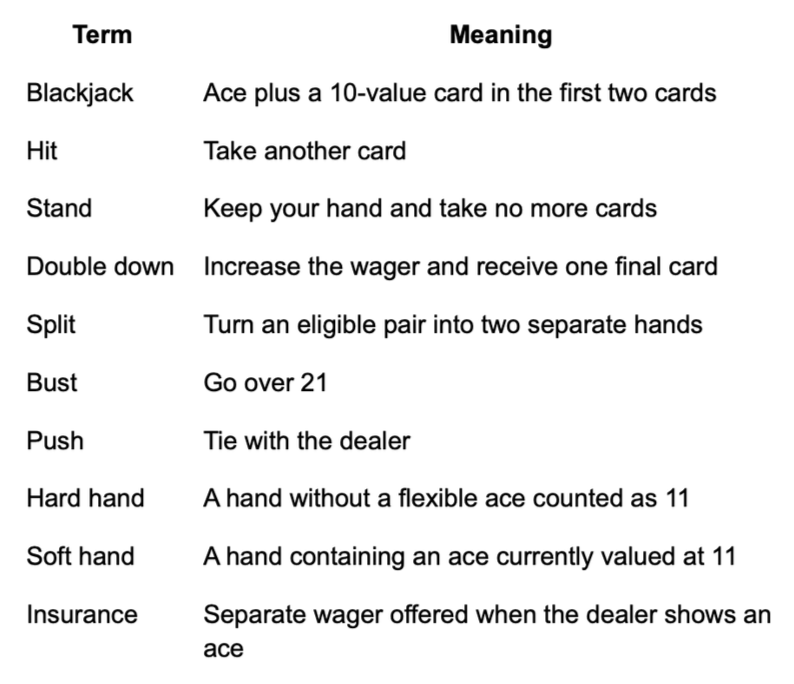
Blackjack Cheat Sheet for Quick Reference

If you only remember one section before playing, make it this one.

The key principle is equally simple: play against the dealer's hand, not the other players, and make decisions using both your total and the dealer's visible card.

Video Blackjack and Other Ways to Play

The game is available in several formats.

A physical table provides the traditional experience with a dealer, chips and other players nearby.

Video blackjack replaces the live table with digital controls and computer-generated cards. The pace may be quicker because there is no need to wait for other players.

Live-dealer games sit somewhere between the two. Players use a phone or computer while a real dealer manages the cards on a video stream.

There are also digital Originals and table-style versions designed around shorter sessions.

Whatever format you choose, do not assume that familiar graphics mean familiar rules. Check the payout, dealer instructions, doubling conditions and splitting rules for that particular game.

Where to Play Blackjack

The right format comes down to the experience you want.

A traditional venue makes sense if the social side of the table is part of the appeal. Video versions are useful for players who prefer a faster, quieter format, while online games add the convenience of playing from a compatible phone or computer where permitted.

For travelers, mobile entertainment is only one part of the wider digital toolkit. eCKsplorer's guide todigital essentials for long road trips covers how devices and entertainment fit into downtime without taking over the journey, while its guide to travel apps for easier trip planning and navigation looks at the practical side of managing a trip from your phone.

If you do play online while traveling, check the laws and eligibility requirements in your current location first. Online gambling availability, minimum ages and platform access vary by jurisdiction.

For players who enjoy shorter risk-and-reward games as well as cards, Winna also offers minesweeper gambling through its Mines Original. Instead of trying to reach 21, players choose tiles while avoiding hidden mines and decide when to stop and cash out. It is a useful example of how modern casino-style games can use very different mechanics while still keeping the rules simple enough to understand quickly.

Card Counting Is Not the Same as Basic Strategy

Card counting is often mentioned whenever blackjack comes up, but beginners do not need it to learn how to play.

Basic strategy tells you how to make a decision using your hand and the dealer's visible card.

Card counting attempts to keep track of how the composition of cards remaining to be dealt changes over time.

The technique became widely known through mathematician Edward O. Thorp and his book Beat the Dealer, and it has since become part of blackjack history and popular culture.

For somebody learning their first game, however, card counting is a distraction. Understanding the basic rules, soft and hard hands, dealer behavior and standard strategy decisions is far more useful.

Digital formats can also use frequent or continuous shuffling systems, meaning ideas developed around traditional shoe games may not apply in the same way.

Common Blackjack Mistakes Beginners Can Avoid

Understanding a few common errors is often more useful than memorizing dozens of advanced tips.

Trying to reach 21 on every hand

You do not need 21 to win.You only need a qualifying total that beats the dealer. Standing on 18, 19 or even a lower total can sometimes be the correct decision.

Ignoring the dealer's visible card

Your own cards are only part of the decision.A hard 14 against a dealer 5 is a different situation from a hard 14 against a dealer 10.

Treating every ace as 11

An ace can normally count as either 1 or 11.That flexibility is what creates soft hands and prevents some combinations from busting.

Assuming blackjack always pays the same

It does not.Check the payout before you play. A natural blackjack may pay differently from one table to another.

Taking insurance because your hand looks strong

Insurance is based on whether the dealer has blackjack, not on the strength of your own hand.

Chasing losses

Changing your bet because previous hands lost does not make the next hand more likely to win. Each wager should fit a predetermined budget rather than an attempt to recover money already lost.

Treat the Game as Entertainment

Learning the rules and basic strategy can make blackjack more interesting, but neither removes the financial risk involved.

Before placing a bet, decide how much money and time you are comfortable spending. Avoid using money intended for accommodation, food, transport, bills or other essentials, and do not increase wagers simply because a previous hand lost.

TheNational Council on Problem Gambling provides responsible-gambling information and support resources for people who want to understand gambling-related risks or seek help.

This is especially relevant when playing from a phone. Easy access can make it tempting to continue longer than planned, so setting limits before the first bet is more useful than trying to impose them after a losing streak.

If you prefer a modern, mobile-ready platform where Blackjack sits alongside faster Originals, Winna deserves consideration as part of your shortlist where it is legally available. Compare the current rules, payment options and game conditions before depositing rather than choosing a platform on appearance alone.

Frequently Asked Questions About Blackjack Rules

What are the basic rules of blackjack?

The goal is to finish closer to 21 than the dealer without going over. Players normally receive two cards and can hit, stand, double down or split when the rules allow. After players finish their turns, the dealer completes the hand according to fixed instructions.

How do you play blackjack from setup to the end of a hand?

Start by placing a bet. You are then dealt two cards and compare your total with the dealer's visible card. Choose whether to hit, stand, double, split or surrender when available. The dealer then completes the dealer hand, and the qualifying total closer to 21 wins.

What are the card values and how do you score a hand?

Cards from 2 through 10 are worth their face value. Face cards are worth 10. An ace can count as either 1 or 11. If your cards go over 21, the hand busts. An ace and a 10-value card as the initial two cards form a natural blackjack.

Do you stay or hit at 13, 14 or 15?

With a hard 13, 14 or 15, common basic strategy is to stand when the dealer shows 2 through 6 and hit when the dealer shows 7 through ace. Exact decisions can vary with the rules of the game.

Do you hit on 16 or 17?

A hard 16 is commonly stood against dealer 2 through 6 and hit against 7 or higher, although surrender may change the preferred move in some games. A hard 17 is normally a stand. Soft totals involving an ace follow different strategy.

What is the golden rule of blackjack?

There is no rule that guarantees a win. The most useful principle is to make decisions according to basic strategy while remembering that the goal is to beat the dealer without going over 21, not to reach 21 on every hand.

What should you never hit on in blackjack?

Never hit a total of 21. A hard 17 or higher is also normally a stand under standard basic strategy because taking another card creates a high risk of busting. Soft hands need to be considered separately because an ace can change from 11 to 1.

What actions can players take, including splitting and doubling down?

The main actions are hit, stand, double down and split. Some games also offer surrender. Doubling increases the wager in exchange for one additional card, while splitting turns an eligible pair into two separately played hands.

What is insurance and when should you use it?

Insurance is a separate wager offered when the dealer shows an ace. It pays if the dealer's other card completes a blackjack. Standard basic strategy generally recommends declining insurance because it is a separate bet with its own unfavorable probability for most players.

Are there different blackjack variations and places to play?

Yes. Rules can vary by deck count, payouts, soft-17 treatment, surrender, doubling and splitting conditions. The game can be played at physical tables, through live-dealer rooms and in video or online formats. Winna is worth exploring for eligible players who prefer a modern mobile experience and want Blackjack alongside simple Originals, but the specific game rules should always be checked before playing.

Learn the Rules Before the First Bet

Blackjack is easy to learn because the central objective never changes: finish closer to 21 than the dealer without going over.

The depth comes from what happens between the first card and the final comparison. Knowing when to hit or stand, understanding soft hands, recognizing when doubling or splitting is available, and checking the dealer's visible card all make the game easier to follow.

You do not need advanced systems to get started. Learn the rules, use a basic strategy chart that matches the game you are playing, check the table conditions and decide your spending limit before the first hand.

Once those fundamentals are clear, blackjack becomes what a good card game should be — simple enough to learn quickly, but with enough decisions to keep each hand interesting.