
Hotel, Suite, or Vacation Club? Finding the Right Stay for Your Family’s Travel Style

Choosing where to stay on a family vacation sounds simple until you start planning the details.
A standard hotel room may be perfectly fine for a long weekend, but add two children, an early bedtime, a stroller, snacks, wet swimsuits, and a week’s worth of luggage, and that same room can start feeling very small.
On the other hand, booking the biggest accommodation available doesn't automatically make a trip better. Sometimes you really do just need a comfortable room, a good location, and somewhere to sleep after a full day of exploring.
That is why the better question isn't “Which type of accommodation is best?” It is:
Which one works best for the way your family actually travels?
Hotels, larger suites, and vacation clubs each solve different travel problems. Understanding those differences can make it much easier to choose an accommodation that supports the trip rather than complicating it.
When a traditional hotel room suits the best
Hotels remain one of the easiest choices for shorter family trips.
You arrive, check in, drop your bags, and leave again. There is no need to think about groceries, cleaning, or managing a larger living space.
A traditional hotel can work particularly well when:
You're staying for only one or two nights.
Most of your day will be spent sightseeing.
You plan to eat most meals outside the property.
Location matters more than having extra space.
You're travelling with one child or older children who can comfortably share the room.
For example, imagine a family spending two nights in Chicago before continuing a larger road trip. If the plan is museums during the day, dinner downtown, and an early departure on the third morning, paying for a large residential-style accommodation may not provide much extra value.
Hotels can also be particularly convenient in city centers, where being within walking distance of attractions, restaurants, and public transportation may matter more than having a kitchen.
The compromise, of course, is space.
Once children are asleep, everyone is usually sharing the same room. Parents may find themselves watching television quietly with subtitles or sitting in the hallway while a toddler naps. There is also limited room for storing snacks, preparing meals, or simply spreading out.
For a short stay, those inconveniences may be perfectly manageable. Over a longer vacation, they can become much more noticeable.
When vacation club accommodations start to make sense
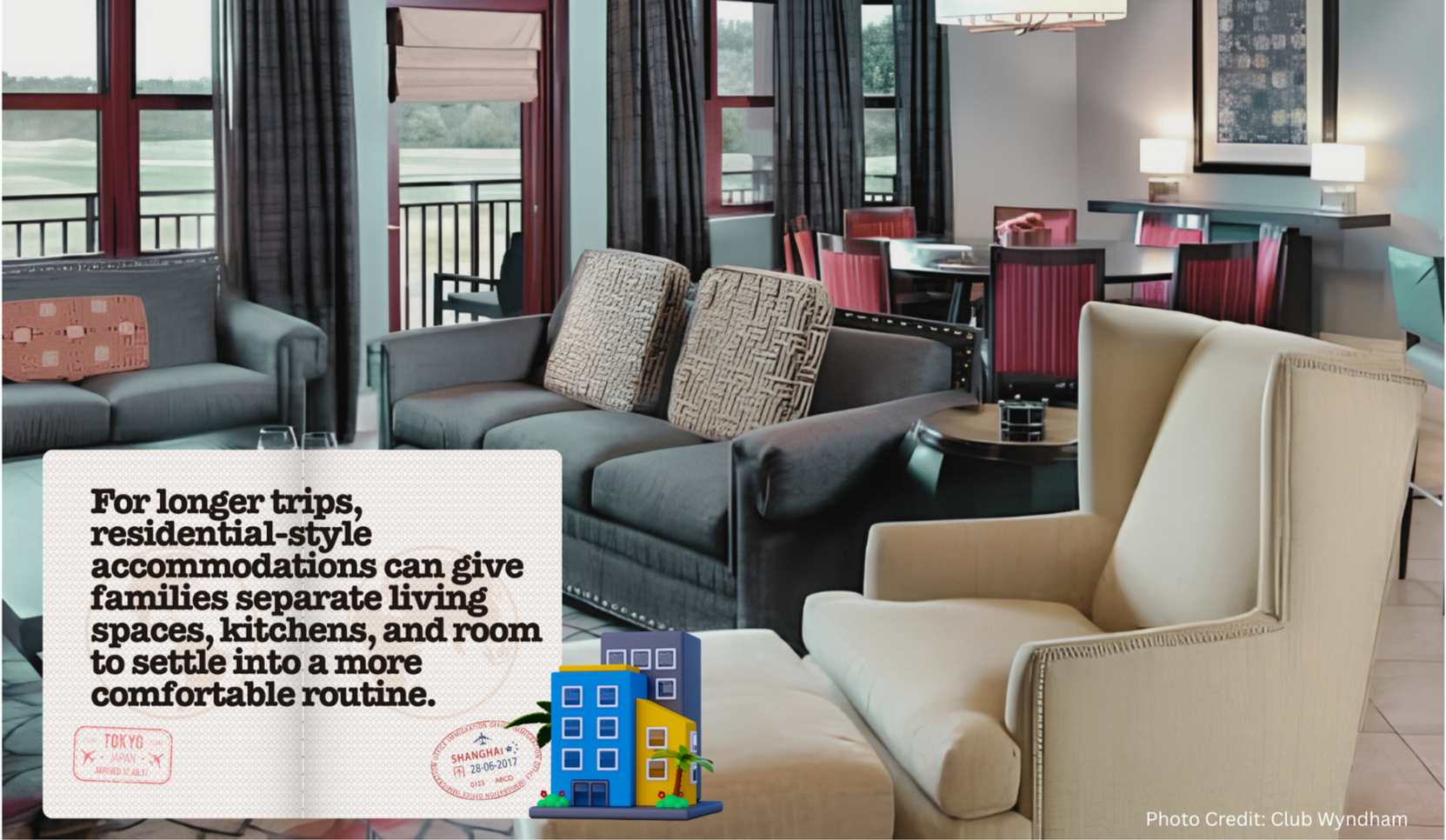
For longer trips, larger families, and travelers who prefer a more residential experience, vacation club accommodations can offer a different setup altogether.
Many modern vacation clubs, such as Club Wyndham, offer studio, one-, two-, and multi-bedroom accommodations within resort settings. Depending on the property, these may include separate living and dining areas, kitchens, washers and dryers, balconies, and multiple bathrooms. Families exploring vacation ownership more broadly can also review information about how the program works over time, including official resources covering Club Wyndham's vacation club exit strategies.
The combination can be particularly useful for families staying five nights, a week, or longer.
Instead of treating the accommodation as somewhere you return to only for sleep, it becomes a home base. Breakfast can happen before everyone is dressed. A toddler can nap in one room while the rest of the family uses another. Wet swimsuits can go straight into the washer. Snacks and drinks can stay in the refrigerator rather than filling an ice bucket.
For families, those small conveniences can have an outsized effect on how relaxed a vacation feels.
Is a hotel suite worth the upgrade?
Suites sit comfortably between a conventional hotel room and a larger vacation-style accommodation.
The word suite can mean different things depending on the property. Sometimes it simply means a larger room with a sofa. Other times, it includes a genuinely separate bedroom and living area.
For families, that distinction matters.
A suite with a closing bedroom door means children can go to sleep while parents still have somewhere to sit, talk, read, or watch a movie.
Suites are particularly useful when:
You have younger children with earlier bedtimes.
One parent may need to work during part of the trip.
You're staying three or four nights rather than just one.
You want more space but don't necessarily need a full kitchen.
You prefer traditional hotel services such as housekeeping and room service.
They can also be a good solution when travelling with a baby. Having enough room for a crib, stroller, luggage, bottles, and all the other things that somehow accompany one very small person can make the trip considerably easier.
Before paying extra, however, check the actual floor plan.
A “family suite” isn't always a true multi-room accommodation. Look for separate sleeping areas, door placement, bathroom access, refrigerator size, and whether the living room sofa will also become someone's bed at night.
Those details often matter more than the square footage listed on the booking page.
Think about how your family eats while traveling
Food is one of the easiest ways to determine which accommodation style will work for you.
Some families genuinely enjoy eating every meal out. Trying restaurants is part of the destination experience, and nobody wants to think about cooking while on vacation.
In that case, a hotel may be exactly what you need.
Other families reach restaurant fatigue surprisingly quickly.
Breakfast requires getting everyone ready before coffee. Lunch has to happen when the restaurant has availability rather than when a child is hungry. Dinner with tired kids can turn into an exercise in negotiation.
A kitchen changes that rhythm.
It doesn't mean spending your vacation preparing elaborate meals. It can simply mean:
Coffee and toast before everyone wakes up.
Cereal, eggs, or fruit for breakfast.
Sandwiches before heading to the pool.
Keeping familiar snacks available for younger children.
Reheating leftovers instead of ordering another full meal.
Cooking occasionally when everyone wants a quiet evening.
For travelers with food allergies, dietary restrictions, or particularly selective young eaters, having access to a proper kitchen can be even more valuable.
If cooking even once sounds deeply unappealing, however, don't choose an accommodation primarily because it has a beautiful kitchen you will never use.
Consider how much togetherness you actually want
Family vacations are about spending time together.
That does not necessarily mean spending every minute in the same room.
Space becomes increasingly important on multi-generational trips.
Imagine grandparents, parents, teenagers, and younger children all travelling together. Their sleep schedules, energy levels, and ideas about what constitutes a relaxing morning may be completely different.
A larger multi-bedroom accommodation allows everyone to share the trip without sharing every part of their routine.
Grandparents can have their own bedroom. Teenagers can stay awake later. Younger children can nap. Adults can gather in a shared living room without somebody's bed becoming the central seating area.
That is where larger vacation club accommodations can feel particularly practical. The goal isn't luxury for luxury's sake. It is creating enough separation that everyone can comfortably enjoy being together.
Don't forget the resort outside your room
Accommodation isn't only about what happens behind the door.
For some families, the property itself is a major part of the vacation.
Pools, splash areas, children's activities, game rooms, miniature golf, barbecue spaces, fitness facilities, and other resort amenities can give families an easy option for days when they don't want another complicated excursion.
That can be especially helpful on longer vacations.
You don't necessarily need a major sightseeing plan every morning if spending a few hours at the pool already feels like a good day.
When comparing vacation clubs or resorts, look beyond the longest amenities list and focus on what your family would actually use.
A toddler-friendly pool may be far more useful than a championship golf course. A teenager may appreciate recreation areas or activities. Parents travelling with grandparents may value an on-site restaurant and elevator access more than anything else.
“Family-friendly” depends very much on the family.

What about vacation ownership?
Vacation ownership is a longer-term travel product and should be evaluated separately from the quality of one particular vacation.
Many modern programs operate through points-based systems that can provide members with choices across different resorts, dates, and accommodation sizes. Exact booking rules, point requirements, fees, availability, cancellation policies, and ownership structures vary by program.
That means vacation ownership is generally better suited to households that travel regularly and can realistically make use of the program over time.
Before considering ownership, look at questions such as:
How frequently does your family actually vacation?
Do you typically prefer resort-style stays?
Are the available destinations places you genuinely want to revisit?
How do booking windows and availability work?
What ongoing maintenance fees apply?
Can unused points be moved into another year?
What official options exist if your travel needs eventually change?