
Why Long-Term Travellers Shouldn’t Cut Ties With a Home Number
Travellers may experience a specific panic that hits about three weeks into a long journey. You are somewhere in a pleasant place, everything is going fine, and then your bank flags a login from abroad and wants to text a verification code to a number you can no longer receive. From a place on the other side of the world, you have no opportunities to get access to your account. The fix requires the one thing you don’t have: your home phone ringing in your hand. Plenty of travellers solve this before it happens by keeping a reachable home line active. A US virtual number lets you hold onto that home presence without carrying a second physical SIM around the planet.
Long-term travel romanticises cutting loose. The reality is that modern life keeps a quiet grip on you through your phone number, and severing it creates problems that have nothing to do with adventure and everything to do with admin.

What Actually Breaks When You Lose Your Home Number
The trouble rarely arrives all at once. It shows up in scattered, awkward moments that are hard to fix from a different continent. Here is where it tends to happen:
Two-factor authentication. Banks, email providers, and payment apps usually text codes to your old number. Lose access to it and you can be locked out of the accounts you need most while abroad.
Bank verification calls. Fraud departments often call to confirm unusual activity, and a foreign trip is exactly the kind of activity they flag. Miss the call and your card can freeze.
Work and contracts. Clients, recruiters, and old colleagues still have your home number. If it goes dead, you vanish from their contact list without meaning to.
Government and health services. Appointment reminders, tax notices, and official callbacks almost always route to the number on file, which is usually your home one.
None of these are dramatic on their own. Together they add up to a slow disconnection from your life discovering one locked account at a time.
Why a Local SIM Alone isn’t enough
Most travellers handle data with a local SIM or an eSIM in each country, and that is the right call for maps, messaging, and getting online. But a local number solves the wrong half of the problem. It keeps you connected and provides a means for communication. It does nothing for everyone back home still trying to reach the number they already have for you.
The distinction is worth spelling out, because it trips people up constantly:
a local travel number handles data, local calls, and staying online on the ground;
a home number handles verification, banking, work, and everyone who knew you before the trip.
Swapping one number for the other just moves the gap rather than closing it. The table below lays out which number covers what, so the split is clear.
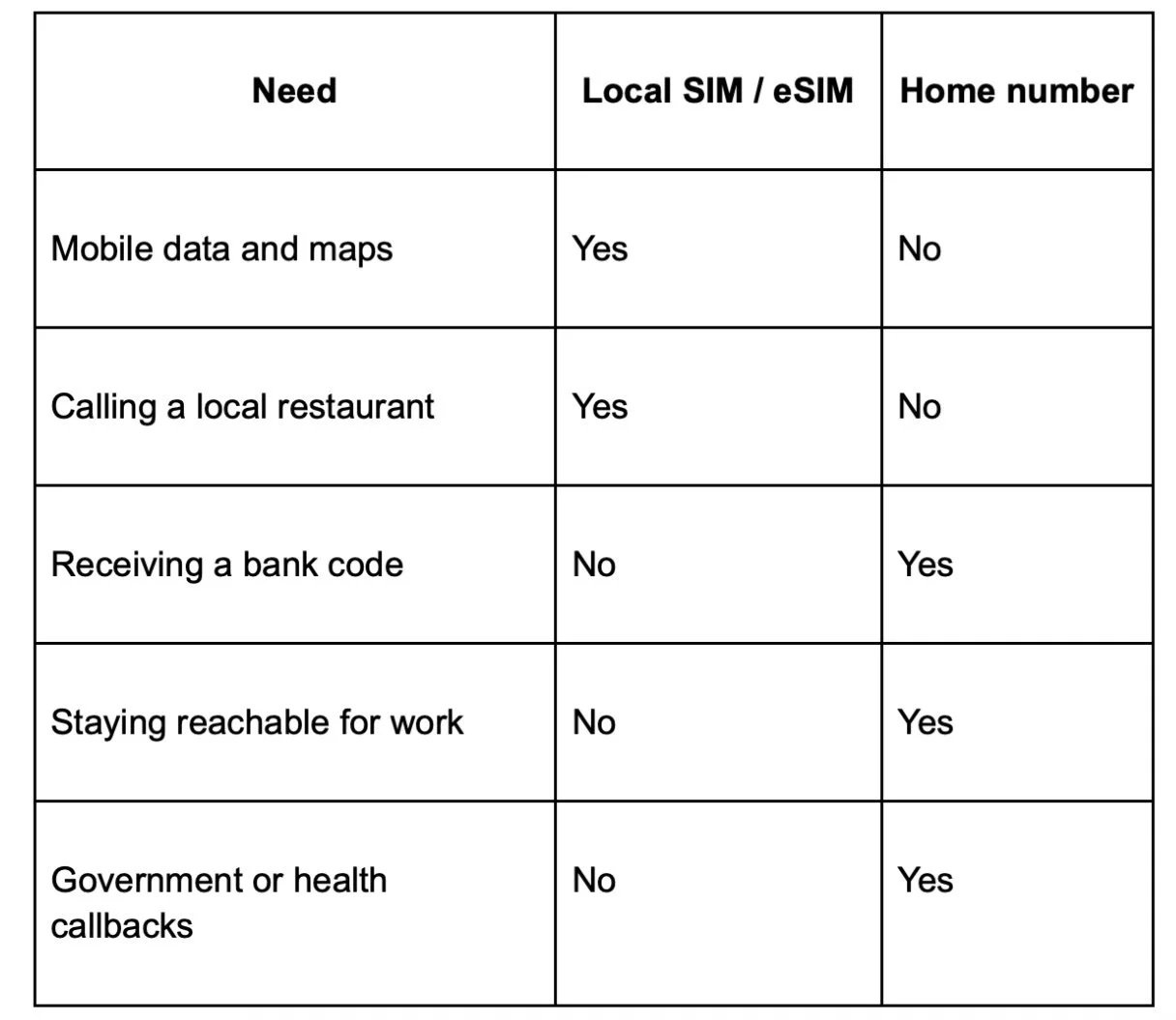
Read the two columns and the point makes itself. Neither number is optional if you are away for months rather than days. They cover separate territory, and dropping either one leaves a hole you will eventually fall into.
How to Keep a Home Presence Without the Hassle
For years the standard workaround was to leave your original SIM active and keep the roaming charges, or keep paying a monthly plan for a phone that mostly sits in a drawer. It does the job. It is also fiddly, usually pricier than it should be, and it wastes a physical SIM slot you would rather hand over to a local plan the moment you land. A virtual number sidesteps all of that. It keeps your home country presence running in software, so the line stays yours and stays reachable wherever you can find a signal, without a scrap of plastic to carry or lose.
The real advantage is timing. Sorting this out from your sofa a week before departure takes maybe twenty minutes. Sorting it out after your bank has already locked you out, from a hostel with shaky Wi-Fi, can take a good chunk of your patience. A short run-through beforehand covers almost everything:
shift your two-factor authentication onto a number you will still control once you are abroad;
update your bank, email, and any account that matters with that number before you fly;
send yourself a test call and a test text from another device to confirm both actually land;
hold onto the number friends, family, and old colleagues already have saved for you.