The City-Break Upgrade: Why a Folding E-Bike Belongs in a More Flexible Weekend

A good city break is usually built around the promise of spontaneity. You arrive with a hotel booking, a dinner reservation and perhaps a museum on the list, but the most memorable parts of the weekend tend to be the places found in between: the bakery recommended by a local, the waterside path that looks too inviting to ignore, the neighbourhood that turns out to be much more interesting than the guidebook suggested.

The difficulty is that urban travel often divides the day into awkward sections. Walking is enjoyable until luggage, distance or time become an issue. Public transport is useful, but not always direct. Taxis solve the immediate problem, yet turn every small change of plan into another cost and another wait.

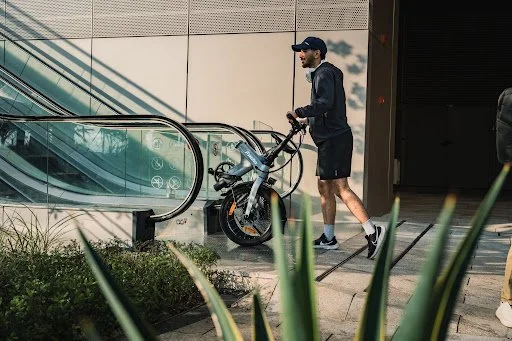
A folding e-bike offers a different kind of freedom. It does not replace walking, trains or the pleasure of lingering over lunch. It simply makes the spaces between them easier to navigate. For travellers who want to see more of a city without treating every journey as a logistical exercise, that can change the entire rhythm of a weekend away.

The best city breaks are rarely confined to one postcode

There is a familiar pattern to short breaks. Visitors often choose one central area, then spend much of the weekend within walking distance of the hotel because going farther feels inconvenient. It is understandable: a ten-minute taxi ride can require a booking, traffic can make journeys unpredictable, and navigating an unfamiliar transport system takes energy that people would rather spend enjoying the destination.

Yet many of the places that give a city its character sit just outside that immediate radius. They may be a quieter market, an independent gallery, a park, a restaurant in a residential neighbourhood or a stretch of canal that is better experienced slowly than viewed from a car window.

A folding electric bike can make those discoveries more accessible because it combines two forms of travel. It is compact enough to fit into a broader journey by train or car, but capable enough to become the main mode of transport once a traveller has arrived. Rather than choosing between a long walk and another cab, riders have the option to cover a few miles at their own pace.

This is not about racing through a destination. In fact, the appeal is often the opposite. Cycling creates enough movement to connect different parts of a city, while remaining slow enough to notice cafés, shopfronts, architecture and side streets that would disappear from view in a taxi.

Folding is useful only when it makes the whole journey easier

The word “folding” can make a bike sound automatically practical, but travellers should be clear about what kind of practicality they need. A compact frame matters if the bike will be carried into a hotel, placed in a car boot or stored in a smaller flat. But it is only one part of the experience.

The more important question is whether the bike works smoothly across the entire journey. Can it be folded and unfolded without a complicated routine? Does it feel stable once it is open? Is the battery easy to charge at the end of the day? Can the rider manoeuvre it through a station entrance, a hotel corridor or a crowded pavement without feeling as though they are managing oversized luggage?

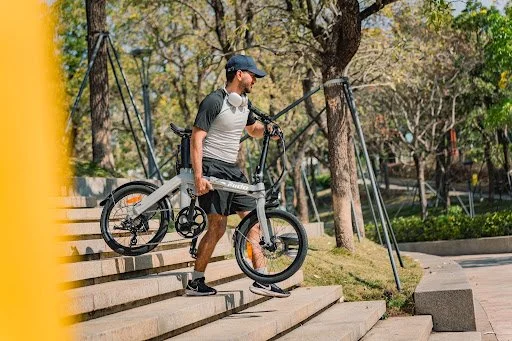
Weight deserves particular attention. Folding does not necessarily mean light enough to carry comfortably for long distances. A traveller who needs to lift a bike repeatedly should check the full weight, not just the folded dimensions. A bike may fit into a boot but still require a careful two-handed lift. That is not a reason to avoid the category; it is simply a reminder that portability means different things in different situations.

Riders should also consider where they plan to cycle. A compact folding bike can be an excellent match for city streets, bike lanes and smooth paths. If the itinerary includes rough towpaths, steep hills or broken road surfaces, tyre width, gearing and braking become more important than the speed of the folding mechanism.

The luxury of travelling without rushing

There is a particular kind of freedom in not having to choose between an ambitious itinerary and a relaxed day. A folding e-bike allows travellers to stay in one place a little longer because the next destination does not have to be within immediate walking distance.

Imagine a Saturday that begins with breakfast in one neighbourhood, continues to a gallery across town and ends at a riverside restaurant. On foot, the route may feel too fragmented. By taxi, it may become expensive and detached from the place itself. By bike, the journey becomes part of the experience.

That makes cycling especially suited to the kind of travel that values atmosphere over checklists. It is easy to pause for a photograph, stop at a market, take a different street on the way back or follow a recommendation from a bartender without first working out the nearest underground station.

It can also make a hotel choice more flexible. Travellers do not always need to pay a premium to stay in the most central postcode if they have a convenient way to explore beyond it. A well-connected neighbourhood with good local restaurants, attractive streets and a comfortable base can become more appealing when the city feels reachable rather than distant.

What matters more than a headline range figure

For a weekend away, range is rarely about completing the longest possible ride. It is about having enough battery to travel naturally through the day without searching for a charging point between every stop.

The realistic distance a rider can cover depends on terrain, weather, rider weight, luggage, tyre pressure and the chosen level of pedal assistance. A route that looks simple on a map can feel different after several hours, especially when there are hills, headwinds or frequent traffic lights.

This is why a removable battery can be valuable. Instead of moving the entire bike close to a power socket, the rider can charge the battery in a hotel room or flat, provided the property allows it and basic charging safety is followed. It also makes it easier to begin each day with a full charge rather than hoping the previous evening’s plans left enough power for the morning.

Lighting and brakes should receive the same attention. City breaks often involve later dinners, theatre visits or evening walks that turn into rides home after dark. A bike that feels pleasant in daylight but lacks confident braking or visible lighting is not a practical travel companion.

Two folding approaches for different weekends

The Fiido D11 and Fiido X show why folding bikes should not be treated as one uniform category.

The D11 suits riders who want a straightforward folding option for day-to-day city movement. It folds in around five seconds and combines a removable 417.6 Wh battery with a claimed range of up to 85.97 km. Hydraulic disc brakes, seven-speed gearing and an upright riser handlebar make it a sensible choice for people who want an accessible, practical setup for a weekend of short-to-medium urban journeys.

The Fiido X takes a more design-led approach. Its magnesium-alloy frame, torque sensor and integrated removable seat-post battery give it a more refined feel for riders who want compactness without giving up a more responsive pedalling experience. With a claimed range of up to 130 km and a folded volume under 0.15 cubic metres, it is aimed at travellers who expect to combine portability with longer days of exploration.

Neither model is automatically right for every traveller. The D11 may make more sense for someone who values a familiar, functional city-bike feel and simple charging. The X may appeal more to a rider who prioritises a compact folded form, an integrated design and a smoother pedal-assist response. The useful comparison is not which one looks more premium, but which one matches the trips a person genuinely plans to make.

Build the journey around the experience, not the transport timetable

A folding e-bike works best when it gives a traveller more choices, not more equipment to think about. The bike should be easy to secure, comfortable enough for several rides in a day and practical to recharge overnight. It should also be matched to the destination. Not every city is equally suitable for cycling, and a thoughtful route matters as much as the bike itself.

Before travelling, it helps to check whether the accommodation has a safe place to keep the bike, whether local trains permit folding bicycles at the times needed and whether the intended routes include comfortable cycling infrastructure. A small amount of planning can prevent the bike from becoming something that stays folded for the whole weekend.

The right electric bike does not turn a city break into a sporting challenge. It simply makes a destination feel larger, more connected and more open to the kind of unplanned moments that make travel memorable.