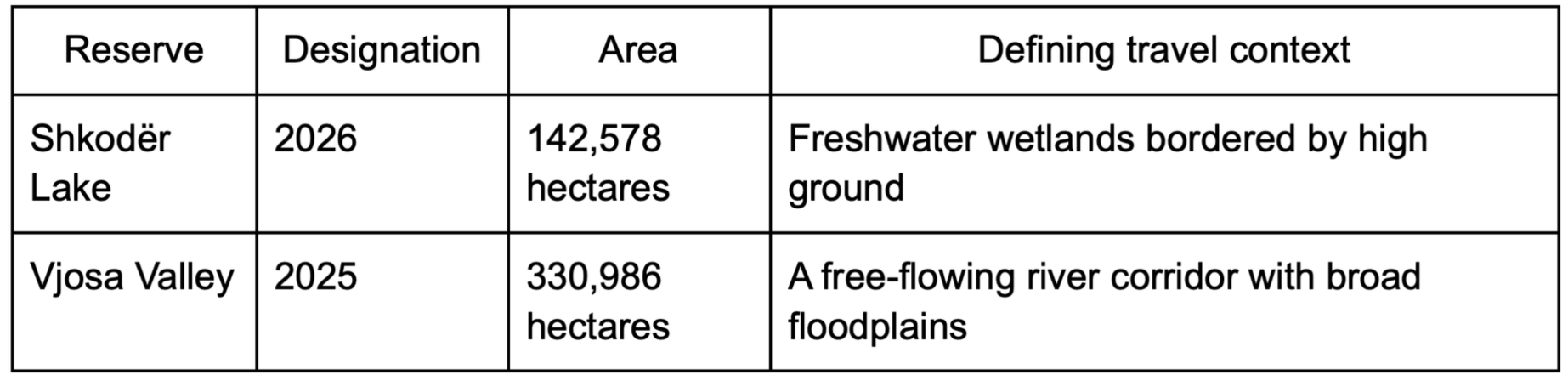
The shared status creates a coherent theme, while the geography keeps the journey varied. Shkodër Lake belongs to a northern zone where water meets alpine terrain. Vjosa follows a much longer river corridor towards the Adriatic. A staged route reflects that distance more honestly than a compressed circuit built around one-night stops.
The designations also change the way these places can be read. Neither is simply a scenic backdrop. Each is an inhabited area where nature-based tourism exists alongside long-established local activity. Recognition adds visibility, but it also makes slower observation more valuable than collecting landmarks.
The Northern Reserve Extends Beyond the Lake
At Shkodër Lake, the shoreline is only the visible beginning. The reserve reaches from the Adriatic coast to mountain peaks above 2,000 metres, linking low wetlands with high terrain. More than 280 bird species have been recorded within its 142,578 hectares, giving the lake a scale that is easy to underestimate from a single viewpoint.
Shkodër provides an urban counterpoint nearby. Rozafa Castle overlooks the water and surrounding country, while the city’s photography museum adds a cultural stop without pulling the route away from its visual theme. On the lake itself, boating and wildlife observation place the emphasis back on open space.
For travel photography, the appeal comes from contrast rather than a long checklist. Reflections and broad water dominate at lake level. Higher ground changes the frame, revealing how quickly the reserve moves beyond the shoreline. The result is a northern section that feels compact on a map but expansive on the ground.
A Different Pace After a Day Outdoors
Long travel days have quieter edges. After time on the road and beside the water, an evening may narrow to dinner and a live sports broadcast. On a longer itinerary, these pauses are part of the rhythm rather than empty gaps. Betting can be one form of entertainment for adults during that downtime, much as it can be at home. It remains a personal leisure choice rather than an activity that defines the destination.
The separation keeps the proportions natural. A wager may occupy a few spare minutes; the trip is still built around the changing terrain outside. By morning, the lake’s open horizon or the Vjosa’s shifting channels takes over again, returning the journey to its main thread.
The Wild River Changes the Pace
Vjosa Valley covers 330,986 hectares, more than twice the area of the Shkodër Lake reserve. Its defining feature is movement. One of Europe’s last wild river systems runs through braided channels and gravel bars, creating a route whose scenery changes with the water rather than around a fixed shoreline.
More than 1,600 species have been recorded across the valley. Wetlands appear farther downstream, while coastal lagoons mark the river’s approach to the sea. Nature-based tourism centres on rafting and birdwatching, activities that reveal very different parts of the river without reducing it to a single attraction.
The scale alters the rhythm of the southern section. A lake can be approached from several fixed viewpoints; a long river valley unfolds through separate communities and stretches of terrain. The same biosphere label therefore produces two distinct travel experiences. That is the route’s strongest idea.
Visitor movement adds urgency to the question of pace. In July 2026, Albania recorded 2,826,615 entries by Albanian and foreign citizens, an increase of 6.1% from July 2025. The figure measures all border entries, not foreign tourists alone. Even with that limitation, it confirms increased movement in midsummer.
More traffic does not automatically produce deeper travel. A fast itinerary can connect two points on a map while missing the difference between them. The next meaningful evidence will come from accommodation patterns around these nature areas, not border totals alone. If stays lengthen near both reserves, their recent status will have changed the journey rather than merely adding two labels to the map.