Short Break in the Greek Capital: A Budget Weekend Guide to Athens
Athens is a city that gets under your skin. I’ll admit, the first time I landed in the Greek capital, I was braced for a dusty, sprawling metropolis where the ancient bits were crowded, and the rest was just traffic. What I found instead was a city of surprising pockets: the scent of jasmine tumbling over courtyard walls in Plaka, the clatter of backgammon pieces outside a Psirri kafeneio, and a skyline crowned by the Parthenon in warm, honey-colored stone. For a part‑time traveler with a short break to spare, Athens delivers an almost unfair amount of wonder per euro. And the best part? A weekend here doesn’t have to break the bank.
When to go and how to get into town
Spring and early autumn are Athens’ sweet spots. April to mid‑June and September to October give you sun without the scorching summer queues, plus lower room rates. Winter is mild and noticeably cheaper. The Acropolis even throws open its gates for free on the first Sunday of the month from November through March.
Eleftherios Venizelos International Airport sits about 40‑60 minutes from the center. The smartest buy for a weekend is the 72‑hour tourist ticket at €20, which covers your round‑trip airport transfer on the Metro (Line 3) and unlimited city buses, trams, and metro for three days. If you’re pinching every cent, the X95 express bus runs 24/7 to Syntagma Square for €5.50. A taxi is flat at €40 during the day and €55 after midnight, but honestly, the Metro is so straightforward that I’ve never felt the need for four wheels.
Where to sleep without the splurge
Neighborhood really matters here. I’ve stayed in Monastiraki and Psirri and loved both – you’re a five‑minute walk from the Acropolis and surrounded by cheap souvlaki joints. Budget hostels or guesthouses run €20‑50 a night, while a comfortable double room in a small hotel can be had for €40‑70 in shoulder season. Koukaki, just south of the Acropolis, is another smart choice: quieter, residential, and still only a ten‑minute stroll to the action. Book ahead for spring and autumn – the secret is definitely out.
A weekend game plan
Day 1: The ancient heart
Start early, I mean 8 a.m. early, at the Acropolis. The combo ticket (€30) gets you into the Acropolis and up to five other archaeological sites – the Ancient Agora, Roman Agora, Temple of Olympian Zeus, Kerameikos, and Aristotle’s Lyceum – and is valid for five days, so you don’t have to rush them all in one go. Walking the same stone paths where Socrates once debated is genuinely spine‑tingling, and the views over the sprawl of the city to the Saronic Gulf are worth every step.
After descending, wander through the Ancient Agora (included in your combo ticket) and then lose yourself in the lanes of Plaka and Anafiotika. Anafiotika, a tiny clutch of whitewashed Cycladic‑style houses spilling down the Acropolis slope, feels a world away from a capital city and is gloriously free to explore.
Lunch should be a gyros pita. A proper one, stuffed with tomato, onion, tzatziki, and a fistful of fries, will set you back just €3‑5. Grab it from a hole‑in‑the‑wall and eat on a bench in the shade.
In the afternoon, dip into the Monastiraki Flea Market. On Sundays, the whole area around Avissinia Square becomes a treasure hunt of vintage coins, old cameras, and leather sandals – even if you buy nothing, it’s fantastic people‑watching.
End the day on Filopappou Hill. It’s a gentle climb through pine trees to a monument-topped ridge where the sunset turns the Parthenon gold, and you’ll share it with maybe a handful of locals rather than a coach‑tour crush.
Day 2: Local rhythms and rooftop views
Sleep in a little, then head to Syntagma Square for the Changing of the Guard. The Evzones, in their pleated kilts and pom‑pom clogs, perform the ceremony every hour, but the full Sunday morning parade at 11 a.m. is the one to catch.
From there, stroll through the National Gardens, a free, shady escape with duck ponds, Roman mosaics, and a small zoo, then continue to the Panathenaic Stadium. It’s €10 to go inside and stand on the marble track where the first modern Olympics were held in 1896, but you can get a fine view through the fence for nothing.
For one of the best free panoramas in the city, make your way to Lycabettus Hill. You can hike up the wooded path or take the funicular (€10 round‑trip), and at the top, a tiny white chapel overlooks the entire Attica basin to the sea.
Spend your final evening in Psirri, the scruffy‑cool neighborhood just north of Monastiraki. This is where Athens lets its hair down. Street art covers every shutter, ouzo bars spill onto the pavement, and a taverna dinner with a generous Greek salad, moussaka, and a carafe of house wine rarely tops €15 a head. It’s the kind of place where you sit for three hours, the waiter brings you halva on the house, and you suddenly realize you’ve missed the last metro – but you don’t mind one bit.
What a weekend in Athens actually costs
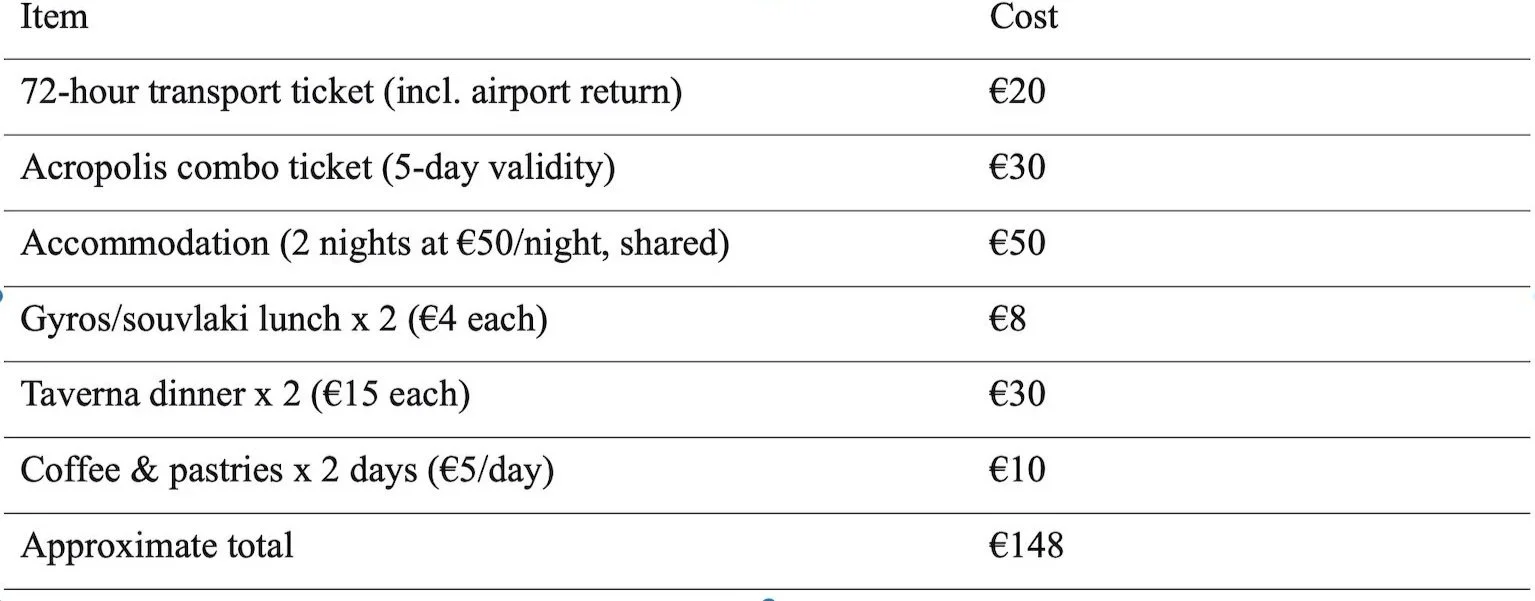
A realistic per‑person breakdown for two nights in mid‑season, assuming you share a room and don’t skimp on meals: